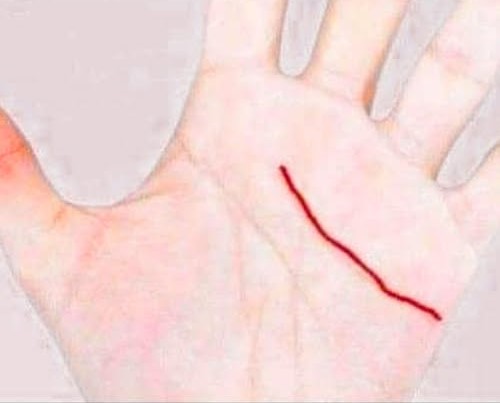
Unlike the other three, the Fate Line does not appear on everyone’s palm. When present, it runs vertically from the base of the palm toward the middle finger. This line is linked to destiny, career, and external influences that shape a person’s journey.
A strong, straight Fate Line is said to belong to people who follow a clear path in life. They often feel drawn to a specific vocation or purpose and tend to pursue it with consistency. A broken or faint Fate Line suggests a more unpredictable life, marked by frequent changes in direction, outside obstacles, or shifting priorities.
Some hands have no visible Fate Line at all. Far from being negative, this absence is often interpreted as independence. Such individuals may resist the idea of a fixed destiny, instead crafting their own path without the weight of tradition or expectation.
The position of the Fate Line also matters. If it begins close to the Life Line, it may symbolize a destiny influenced heavily by family or upbringing. If it starts further away, the interpretation leans toward independence and self-determination.
A Map of Reflection, Not Prediction
One of the most important lessons in palmistry is that no two hands are identical. Even the two hands of one person can differ significantly. Traditionally, the dominant hand is said to reveal the present and the future—the choices we actively make—while the non-dominant hand represents inherited traits, potential, and the influence of the past.
Palmistry enthusiasts stress that the practice is less about fortune-telling than about self-discovery. The lines of the hand shift and evolve over time, reflecting changes in mindset, circumstances, and personal growth. A faint line may deepen after a life-changing event; a break may smooth as resilience takes root. In this way, the palm is seen not as a fixed script but as a living record.
Exploring the Heart, Head, Life, and Fate Lines offers an invitation to self-reflection. Do you lead with passion, or do you guard your emotions? Do you favor logic, or do you trust intuition? Do you crave stability, or do you thrive on constant reinvention? Do you feel bound to a destiny, or do you believe you are free to chart your own?
Palmistry cannot answer these questions for you, but it can spark them—reminding us that beneath every line lies a story worth listening to.
In the end, perhaps that is why this ancient practice endures: not because it predicts our future, but because it gives us a way to pause, look at our hands, and reflect on the lives we are shaping every day.
